Design your own.
Ever thought of designing your own iron railing or gate? But a custom made is going to be expensive right….No is the short answer.
I can show you a way to design you own wrought iron work and still keep the cost down. You will get a made to measure piece of wrought iron work, but to your custom design. It wont be as expensive as you think. As long as it follows a few rules, those I will explain as we go along. Making it as simple as I can. This is best viewed on a laptop or desktop, as mobile wont show enough detail on the drawings.
This process works for most pieces of iron work, Gates, Railings and Juliet balconies. The principle is the same for all of them but there are differences. When those difference occur I will make sure there are relevant web pages to explain it.
You can’t teach years of experience in ironwork design in a few short web pages, so there is quite a bit of reading to do. Once I have a working text version, I will attempt to introduce video to make it more interesting. There will also be some non-essential reading, which I have included for context and a deeper explanation of things. I will make sure to provide a button that allows you to bypass this and scroll on to the more essential sections, should you so wish.
Just a quick note, this was originally written for iron railing design. So it will mostly reference railings and use examples of railings until, it gets more specific .
There are a number of factors that have an effect on the cost of any wrought iron piece. Design is one of them or the time spent getting a design right. Removing that time spent also means removing that cost. This is the part you are going to remove from the cost. By designing your own.
It can become very easy to spend an hour or more designing a railing for a customer. But if that railing only takes two hours to make in an unpainted version. In reality it has taken 3 hours of your time. You have to add that design time to the cost of the iron railing or gate. Changing the length of a railing changes the number of upright bars in that railings. That means your design changes. Which means a new drawing to cover than size.
One of the other factors that has an effect on cost is repeatability, If it is something that is repeated can you make tools to speed up the process. The answer to that is almost always yes. This is why those railings sold in DIY stores and cheap internet suppliers are so cheap. Mass production. Produce a limited number of sizes and have tools to do it quickly. Hence keep the cost down. The problem with made to measure, is those tools don’t work. So it often takes 50% longer to make. because everything must be done by hand.
The other factor that has an effect on cost, is thickness of material used to make a gate or railing. The lighter weight it is the cheaper the material cost. The cheaper you can sell it for. Square uprights are rarely used in any of the mass produced work. because square is always more expensive than round. hence you might notice that almost all of the mass produced ironwork is made from round bar. But using only round upright bars excludes so many design possibilities. If you are doing made to measure you tend to use heavier material than the mass produced items, because people expect better quality from made to measure.
Steel prices are usually set by volume. The more you buy the cheaper it is. But discounts are usually based on a single item. buy 100 length of 12mm round and it will be cheaper. With made to measure that doesn’t work so well. As it depends on what the customer specifies they want. buying a mixed bundle 100 pieces of 12mm round and Square, wont get you the same price.
In short you can never compete with the mass produced items, when doing made to measure. But then neither can the mass produced companies. Not saying which company but they run out a set of mass produced 10ft wide driveway gates for about £250 (as of sept 2026). They also offer made to measure service, which is over £500 for the equivalent size. Seems a bit step to me for made to measure considering what it was made from in terms of steel thickness.
How it works.
The principle is very simple, take a plain simple railing or gate as your base, add detail to that railing using pre made parts to create a decorative bar. Know the cost of the plain railing and know the cost of the decorative bars you add. Total it up and you have the cost of your railing.

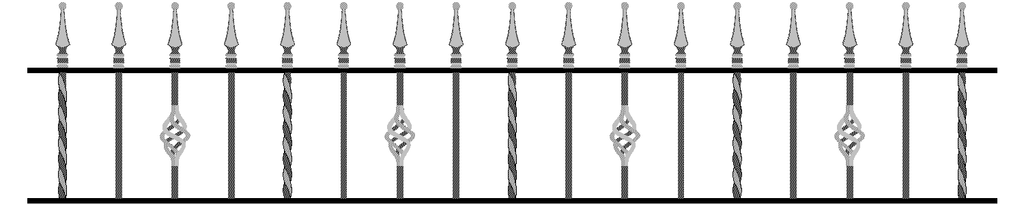
But of course it isn’t just decorative uprights, there is a large choice of top decoration to your railing. All can be change to make your design as unique as possible. This means there a 10,000s of possibilities. Far to many to ever draw.
Permutations
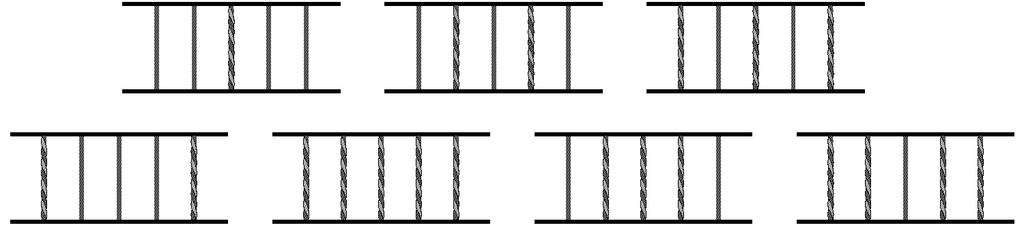
So just as a quick demonstration of why there are so many possibilities. Assume you have a small railing lets say around 650mm long, it will contain 5 upright bars. Working out from the centre, and using it as a line of symmetry Just using a twist bar as your sole piece of decorative design Replacing those plain bars with a twisted one. There are 7 possibilities in terms of railing design.
Now if you decided that maybe your preferred a basket rather than a twist, you still end up with 7 possibilities but it would look like this
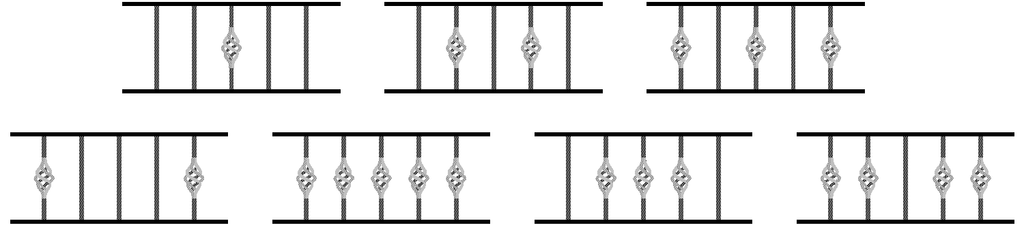
The baskets have only replaced the twisted bars. Replace those baskets with rings, and you get the same 7 designs just with different parts. But start mixing those parts and you start to get more possibilities. mixing the two together gets 12 possibilities.
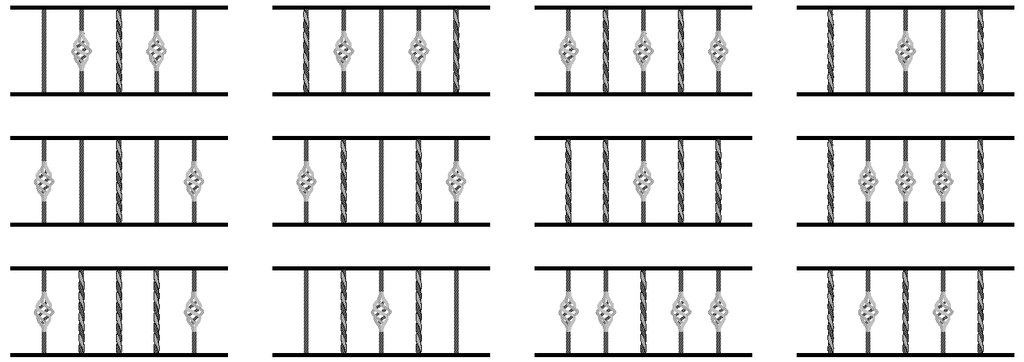
Using just 2 parts on a small railing with 5 bars gives you 26 possible designs. Adding a third part increases the options even more. With the 9 parts I usually use, there are a massive number of possible combinations even on such a small railing. And we haven’t even talked about top decorations yet. Plus, there are a few tricks to get even more railing design ideas. To be honest, out of those 26 designs, I would throw away 15. Only 11 are worth serious thought in my opinion. I won’t point them out because everyone likes different things, and I don’t want to sway your opinion.
The first thing we should look at is the parts, their limitations and how they can be used to create a decorative bar. This is common to everything gates, railing and Juliet balconies.
