wrought iron railings
wrought railings custom-made to your measurements, not limited to standard sizes. This ensures exceptional flexibility in design and size to perfectly suit your needs. Why buy mass produced sizes and cut them down to fit, when you can have an iron railing that was designed to fit.
The website is currently under reconstruction, content is being added as fast work load allows.
Internal Page navigation
Menu
All iron railings are made in our workshop in Crawley, West Sussex. Due to the weight and nature of our work, we mainly serve clients in Sussex, Surrey, and Kent, usually within 30 miles of Crawley. However, for larger projects, we may extend our service area.
Iron Wall railings
Iron wall railings are often the perfect finishing touch to any garden wall project. They also serve as the first feature that visitors notice when approaching your home. That’s why it’s important to make an impression, with a good quality iron railing.
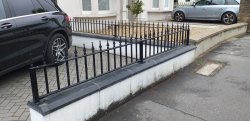
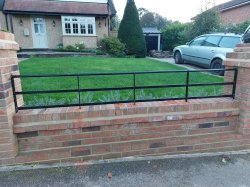
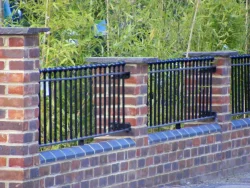
Selecting the right design is essential, which is why we offer an extensive library to inspire you. Alternatively, you are welcome to create a custom railing, and I would be delighted to provide a quote for its construction. Custom designs are not always as expensive as you think.
We understand that garden projects often exceed their budgets, leaving less available for metal railings. That’s why we offer a budget-friendly range of high-quality metal wall railing. Affordable without compromising on quality, and more cost-effective than our standard custom made Designs.
Click the link below to look at our dedicate iron wall railing page.
wrought iron Fencing
Wrought iron fencing typically requires steel posts to securely connect sections and create continuous runs. These can be great when you want an impressive boundary fence, but don’t want to go to the expense of brick work. Wrought iron railings can be a cheaper and just as impressive alternative.
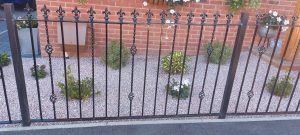
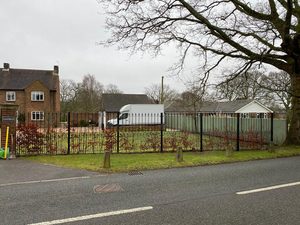
One of the great advantage of wrought iron fencing, is that it can be made to follow the slope of the ground. This makes it an ideal choice where the ground is not level.
Patio railings and Roof railings
While fencing often features decorative railing tops, patio railings typically have flat or convex bars along the top. Making them ideal for preventing falls from raised patio areas. Building regulations require any drop greater than 600mm, is protected by a barrier at least 1100mm high.
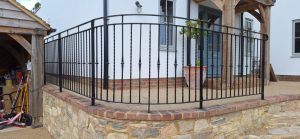
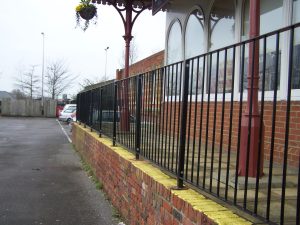
Patio railings also need to be sturdier than typical fencing. A patio or roof railing must withstand the force of someone leaning or falling against it. Therefore it should be constructed from thicker, more durable materials than a lightweight fence panel. Ideally Patio railing panels should be less than 1800mm long, preferably around 1500mm long. To much distance between the connecting posts is not a good idea as this will introduce flex.
Stair rails or handrails
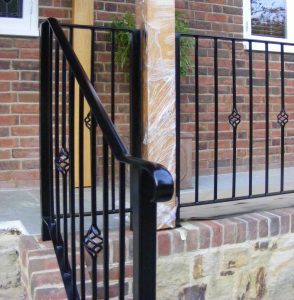
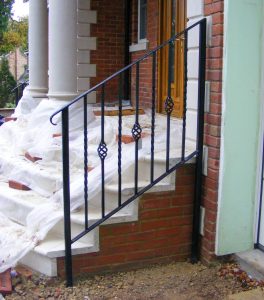
Handrails are a valuable addition to exterior steps, offering greater strength and durability compared to wooden rails. They can be designed to be simple and functional or stylish and decorative, enhancing both safety and appeal. The important part for a stair rail is to make sure it has adequate support, in terms of good posts and fixings. Ideally for building regulation a hand railing on steps should be 900mm high.
Juliet balconies
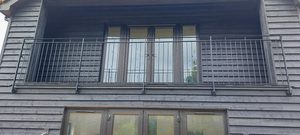
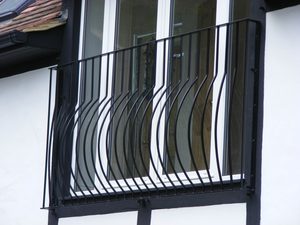
Juliet balconies are essential for preventing falls from French doors, they should comply with current UK building regulations. But in terms of design they can be simple or stylish depending on your taste. Most Juliet balconies are fixed to brick work, this means there true size needs to be at least 300mm wider than the door opening. This ensures any fixings are not on the edge of the brick where they could crack and lead to a poor fixing.
Some Juliet balconies will need fitting to a tile hung wall. These take a slightly different approach to fixing as the only solid fixing point will be the structural timber that holds the door in place. We have a solution for this, with a different type of fixing to the standard Juliet balcony.
Wrought iron railing designs
When it comes to wrought iron railings , there is a massive choice in design. From the simple to the highly ornate, or something in between. I aim to offer as much choice as possible, when it comes to railing designs. Because I know we all have our own personal tastes of what we like and dislike.
Offering only a few designs is simpler but dull. Who wants the same as everyone else? We all want to show our individuality in our homes, and metal railings should be no different. As a small metal worker, I can offer more choices because I have flexibility. Not having to stick to a few designs but having the ability to work according to your design needs.
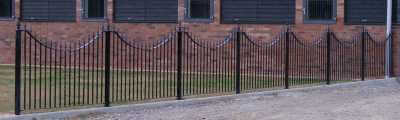
Wrought iron or metal railings is a broad term encompassing various styles. It includes garden wall railings, with fencing essentially being a taller version of wall railings. By removing decorative spikes or railing heads and replacing the top bar with a contoured one, the design transforms into patio or roof terrace railing panels.
When built on a slope, it becomes a handrail for stairs or ramps. Attaching a patio railing to a wall makes a Juliet balcony. These types can have the same design, which helps keep a consistent and unified look in railing design.
Design library
I have slowly begun to publish, my extensive library of CAD drawings. Which have been done over many years. This contains massive amount of design ideas for wrought iron railings.
Some of which can be found here at the link below.
If you wish to design your own railing, some help can be found. On our testing server a project was started, which aimed to help in the aid of designing your own wrought iron. Although currently not a complete tutorial yet, there is some useful information there that can help you on your journey. it can be found here.
Part K building regulations in brief.
Part K is the area of UK building regulations that covers. Steps, handle rails, patio railings. Juliet balconies etc. In short it says.
All falls of over 600mm should be guarded by a barrier or railing. So a raised patio where the difference in height is more than 600mm from ground level, should have a guard rail. The guard rail must not allow a sphere of more than 100mm to pass through any gap. This means the upright bars in a metal railing must not exceed 100mm apart. The guard rail should be 1100mm high.
Handrails going down steps should be a minimum of 900mm from the nose of the step. These are for residential railings.
Why use steel for railings.
Steel is an exceptional material for railings due to its remarkable malleability, allowing it to be easily bent, shaped, and welded without sacrificing its inherent strength and durability. Because steel is highly weldable, fabricators can effortlessly incorporate prefabricated components to create intricate, complex, and visually striking designs. With proper maintenance and care, a steel railing will last a lifetime.
